
I Can't Out-Run My Genetics: What Happened When I Actually Tested Everything
Data, Testing, Apps, and Medicine 3.0
I'm on an interesting health odyssey. Some may call it a deep dive, others say overkill. As an information junkie, I track a lot. I live by the motto that knowledge is power. And now that I'm officially 60, my health is increasingly taking center stage. I'm noticing some aspects are in good shape while learning others need attention. I love testing emerging technologies - wearables, apps, health services - and I thought I'd share what I've done to open up the conversation. This is new territory for all of us, so the more we share, the better. You may have explored this space even more deeply than I have, which reminds me that this is shared terrain we’re all navigating.
How It Started
My LCIS diagnosis at Memorial Sloan Kettering was the catalyst. LCIS isn't cancer, but it's a serious warning signal requiring ongoing monitoring. This happened just before I dove into endurance training - signing up for my first Grand Canyon Rim2Rim2Rim and the NYC Marathon in the same year during the pandemic. Endurance training accelerated my interest in data. It's natural for runners to get excited about tracking performance metrics, especially when you have a 3-4 month training cycle that rapidly reveals the honest state of your health. Suddenly everything - timing yourself on trails, nutrition for optimal performance, how your muscles and ligaments respond to training, sleep quality and recovery - all becomes interconnected. I'm learning now to balance data with "feel." Both are valuable for understanding baseline health.
So welcome to my madness. Here's what I'm tracking in this Medicine 3.0 journey (yes, that's what some refer to this convergence of medicine and technology today).
Sleep
I started tracking sleep with my Oura ring a few years back. It was a slippery slope. Early reports showed I was waking 10-12 times a night with almost no deep sleep, averaging 5 hours while marathon training. I freaked out and booked a consultation at Weill Cornell Neurology Sleep Center to rule out sleep apnea. Good news: we ruled it out after a restless night hooked up to probes. I also stopped obsessing over my Oura ring. If I sleep well - I know it and that’s what matters.
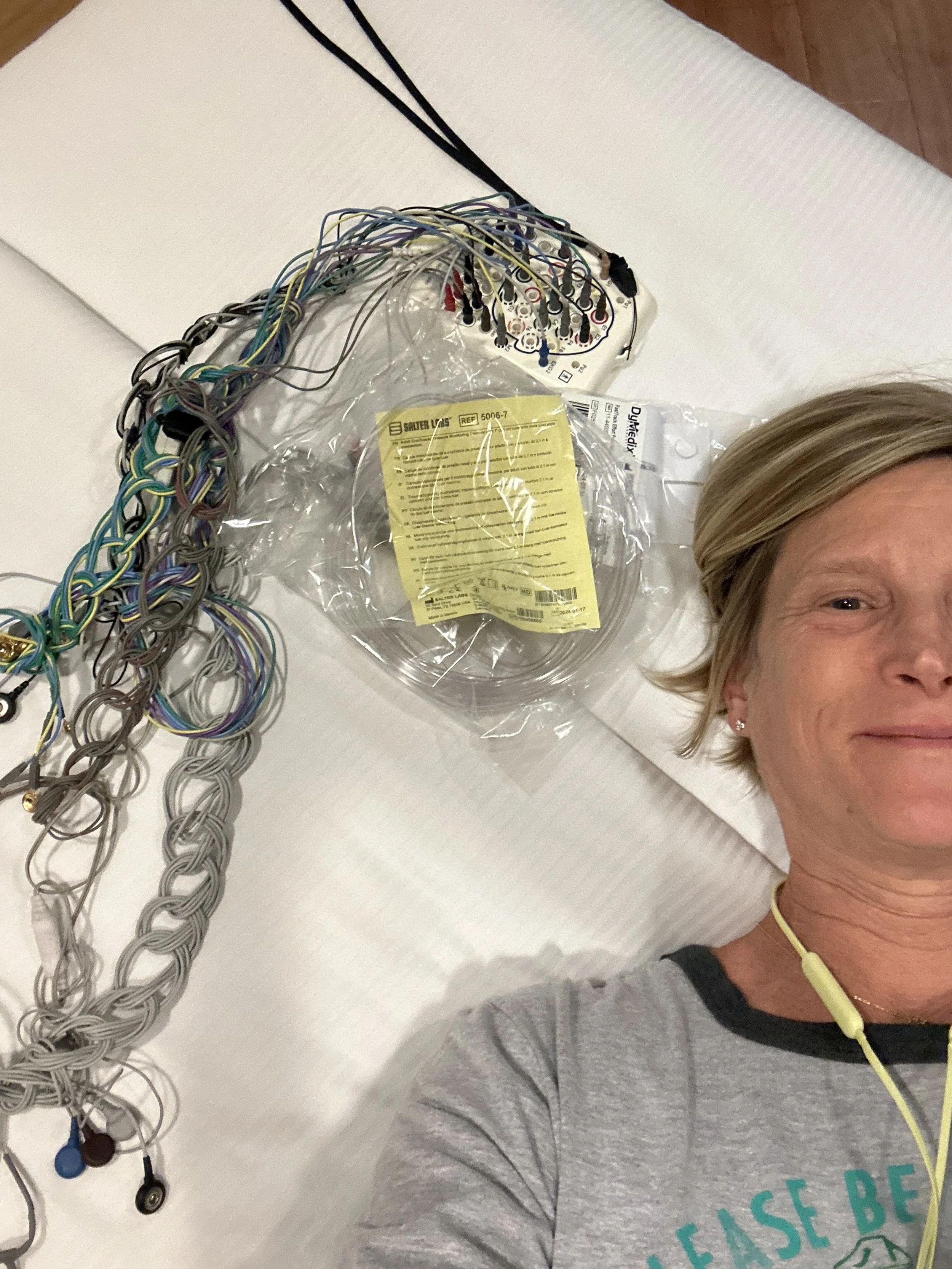
What I Learned
What I learned: I needed better sleep hygiene. That meant resisting the urge to fall asleep at 8pm on the couch, staying awake until 10pm to increase productive sleep blocks, reducing sugar intake, limiting caffeine to 2 cups before noon, and accepting that wine wrecks my sleep - I wake at 1-2am and ruminate for hours.
I'm glad I went through the process to confirm its not full blow sleep apnea.
Workouts
I log all workouts on my Garmin Fenix - my go-to marathon and endurance watch with GPS and solar backup power. It syncs with Strava, where our VITAL Adventure training teams track distance, pace, elevation, and heart rate. But honestly, the team support and high fives matter just as much as the data. The metrics keep me honest; the community keeps me going.
I also work with running coach Heather Knight, who uses V.02 to program and monitor my training. Between Garmin, Strava, V.O2, and Oura, you can see how quickly the tech stack grows.
My advice? Pick one or two tools that actually serve you. More data isn't always better - it's just more overwhelming. Start with what gives you useful feedback without creating anxiety, and build from there if it makes sense.
Beyond the daily tracking, I enrolled in a head-to-toe performance evaluation at Performance Optimal Health using TechnoGym systems full Wellness Assessment covering body composition, mobility, flexibility, strength, mental acuity, and cardiovascular fitness. I did these tests post-calf injury last spring, and it was eye-opening to see what contributed to getting injured: limited ankle mobility and range of motion, weak posterior chain (yes, running miles doesn't mean strong glutes, quads, hamstrings, and calves), and obvious overuse. The data revealed what I couldn't feel - the weak links that finally broke under training load. I addressed this with physical therapy and continue working on these areas.
Curious how this kind of preparation translates to the trail?
Function Health
There's lots of talk about ApoA, ApoB, and what tests actually reveal about our health. I know I'm genetically going to go the way of my mom or dad - now I know which way. My running coach suggested Function Health to get a baseline read on my heart, hormones, kidneys, liver, thyroid, and more. I subscribed to their annual membership, which requires visiting Quest Diagnostics twice yearly for blood draws shipped to Austin for evaluation by their medical team. The membership includes 100+ lab tests across every major organ system, plus 60+ follow-up tests halfway through the year. You can add Advanced Add-Ons like Galleri, MRI, and CT scans for additional cost.
After my tests, a great deal was revealed. I'm rocking my biological age, but some findings require attention. My cardiovascular panel showed a mixed picture. Inflammation markers are excellent - my hs-CRP is optimal - but here's what got my attention: my Lipoprotein(a) is significantly elevated at 280 nmol/L (optimal is under 50) and trending upward. This was a wake-up call. Lp(a) is largely genetic and an independent risk factor for heart disease and stroke that doesn't respond to lifestyle changes alone.
My LDL particle number, ApoB, and small LDL particles are all elevated. It's not just about total cholesterol - it's about particle size and number. Small, dense LDL particles are like BB pellets that damage arteries, while large, fluffy ones are like beach balls that bounce off.
My particle size decreased below optimal range - more damaging BB pellets circulating. My Omega-3 levels also dropped significantly which matters for heart protection - so I’ve upped my Omega-3 supplements as a result.
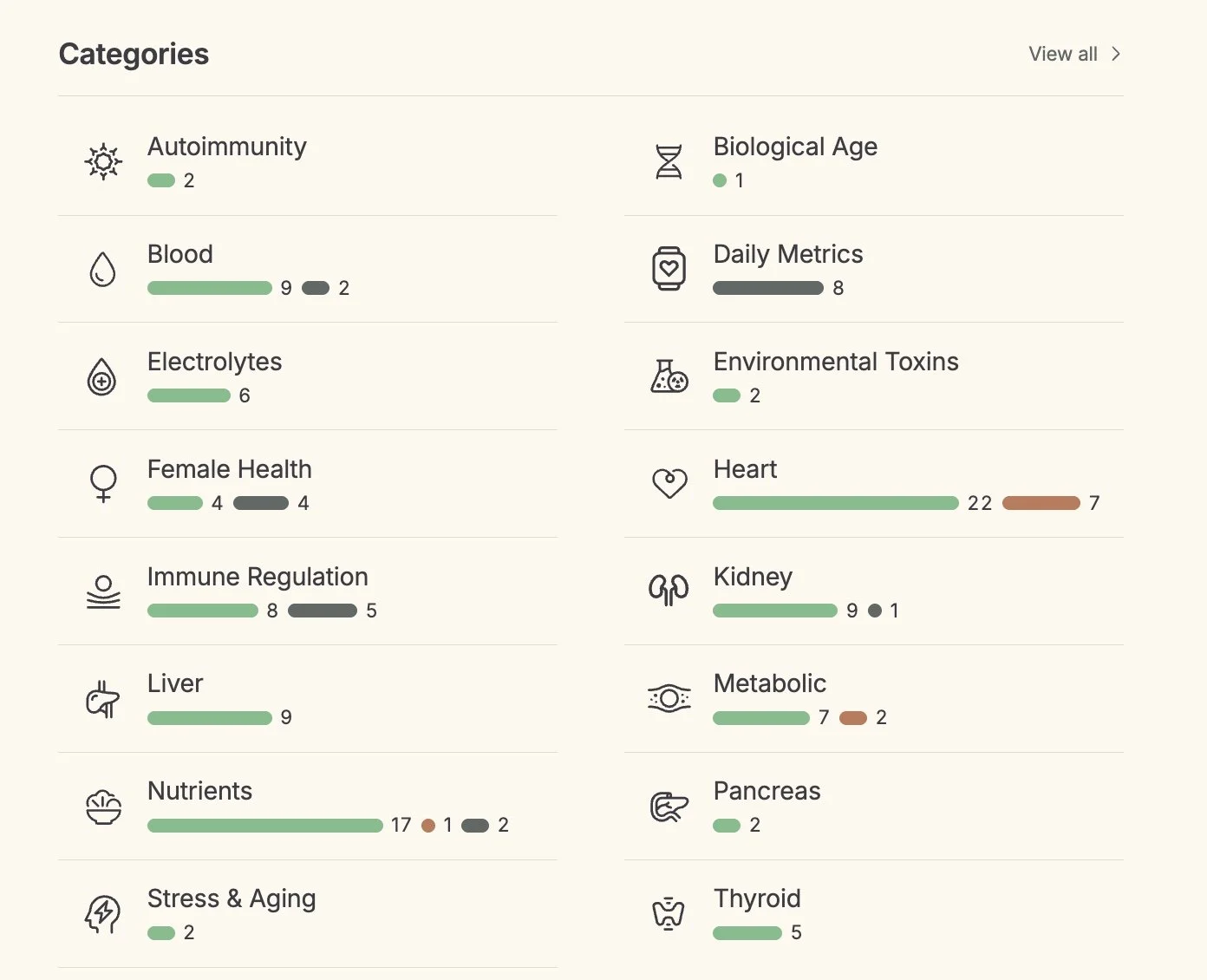
FUNCTION Health Lab Test Summary: Brown: Out of Range. Green: In Range. Grey: Other
This is exactly why I signed up for Function Health. Standard cholesterol tests would miss this entirely. I might have thought my cholesterol was "fine" when the type and number of particles matter far more.
I'm now working with a cardiologist and seeking care that reflects what the data is actually showing - because genetics are at play regardless of a good diet and regular exercise.
Here's my takeaway: you can't out-train your biology, but you can partner with it. This information simply starts important conversations with healthcare providers who can actually guide next steps. Knowing this now gives me agency - not certainty, but a chance to be proactive.
If you're exploring this territory too, I'd genuinely love to hear what you're learning. I don't have this figured out - I'm navigating it one day at time.
So…here's to honoring the health we have and being brave enough to look closely at what needs attention.
x Libby
Ready to Understand Your Own Strength More Deeply?
If reading this sparked something — curiosity, a desire to train smarter, or the urge to take on a big physical challenge — you’re exactly who our Discovery Sessions are for.
In 30 minutes, you’ll learn:
Which Adventure is right for you
What the training program includes
How we help people of all ages step into physically big adventures